OMEGA vs Mem0 vs Zep.
An Honest Comparison.
Three architectures. Two benchmarks. Real numbers. Which AI memory system should you actually use?
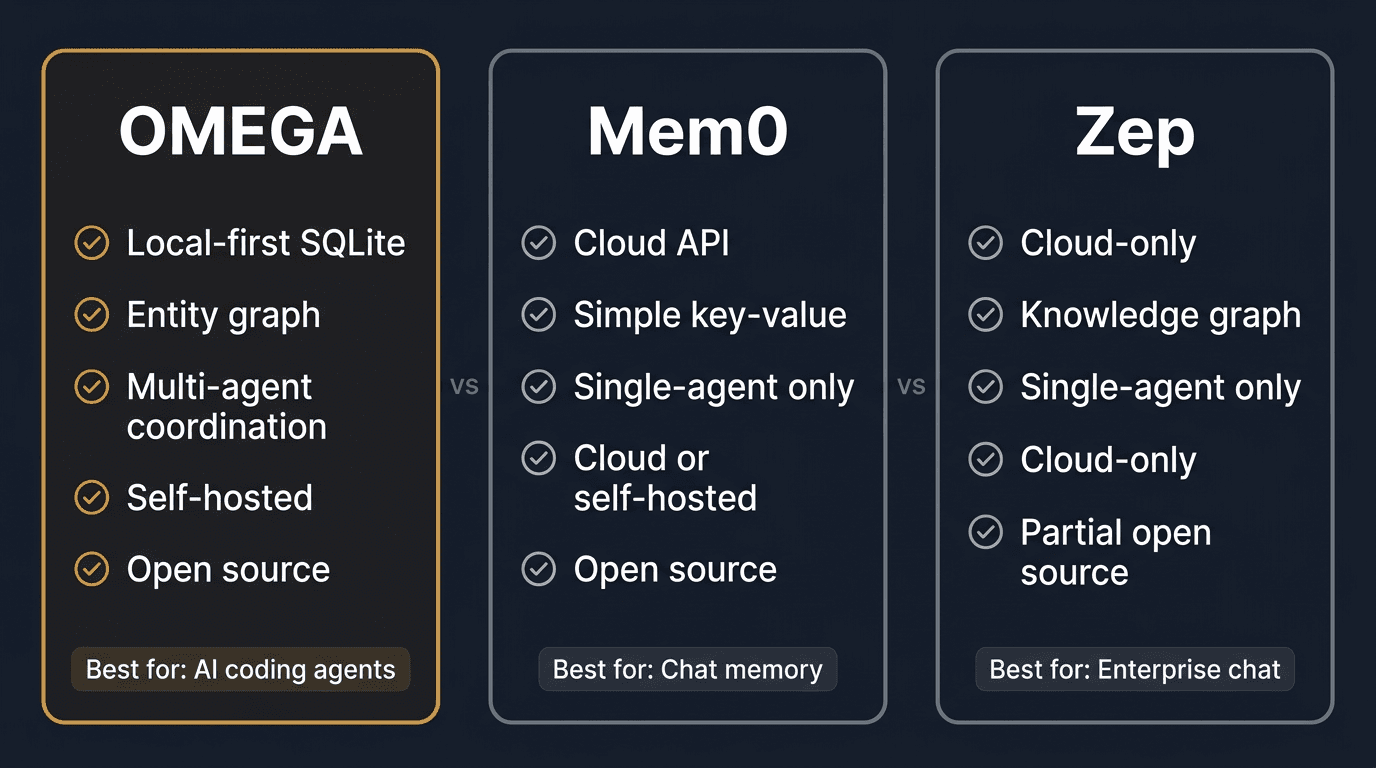
If you're adding memory to an AI coding agent in 2026, you're choosing between three fundamentally different architectures: Mem0's cloud-first platform, Zep/Graphiti's temporal knowledge graph, and OMEGA's local-first semantic store. Each makes different tradeoffs. This post walks through the real differences, with benchmark data, not marketing claims.
I built OMEGA, so I'm biased. I'll tell you where the other systems are genuinely better. But I'll also show you the benchmark numbers, because those aren't subjective.
The Contenders
OMEGA
$0 fundingLocal-first MCP memory server
Mem0
Undisclosed (YC W24) fundingCloud-first memory platform
Zep / Graphiti
$4.5M fundingTemporal knowledge graph
Benchmark #1: LongMemEval
LongMemEval (ICLR 2025) is the standard benchmark for AI memory systems - 500 questions across six categories testing recall, updates, preferences, temporal reasoning, and multi-session reasoning. It's the number every memory system is measured against.
| System | Score | Note |
|---|---|---|
| OMEGA | 95.4% | #1 overall. Local retrieval pipeline. |
| Mastra | 94.87% | Agent framework, not standalone memory. $13M funded. |
| Zep / Graphiti | 71.2% | Self-reported. Graph-based approach. |
| Mem0 | N/A | No published LongMemEval results. |
The gap between OMEGA (95.4%) and Zep (71.2%) is significant - 24 percentage points. Mem0 hasn't published LongMemEval results, which makes direct comparison impossible on this benchmark. Mastra scores close (94.87%) but is an agent framework, not a standalone memory server.
An important caveat: LongMemEval tests recall from ~40 clean sessions. It doesn't test what happens over hundreds or thousands of sessions. That's what MemoryStress is for.
Benchmark #2: MemoryStress
I built MemoryStress to test what LongMemEval can't: what happens when a memory system runs for 1,000 sessions over 10 simulated months. Contradiction chains. Cross-agent handoffs. Single-mention facts buried in noise. The kind of pressure real usage produces.
38.3% sounds low, but the benchmark is intentionally brutal. It asks about facts mentioned once, 600 sessions ago, now buried under 582 other facts and contradicted twice since. No other memory system has published MemoryStress results yet. I'm publishing the benchmark as open data so anyone can test their system.
The key finding: OMEGA's retrieval peaks at Phase 2 (~session 300) and degrades gradually, not catastrophically, through Phase 3. A compression-based architecture would show a cliff - once the context window fills, evicted facts are gone forever. OMEGA's persistent store means facts are harder to find, not lost.
Architecture: What Actually Differs
The three systems represent genuinely different architectural philosophies, not just different feature sets. Understanding this matters more than any feature checklist.
| Dimension | OMEGA | Mem0 | Zep / Graphiti |
|---|---|---|---|
| Setup complexity | pip install omega-memory && omega setup | Docker + PostgreSQL + Qdrant + OpenAI API key (local), or cloud API key | Neo4j 5.26+ or FalkorDB (self-host), or Zep Cloud account |
| Data location | Single SQLite file on your machine | Cloud servers (default) or local Docker volumes | Neo4j instance (local or cloud) |
| Embedding model | Bundled ONNX model (CPU, offline) | OpenAI API (requires key + network) | OpenAI API or self-hosted |
| Memory structure | Flat semantic store + relationship graph | Flat key-value memories + graph (paid) | Temporal knowledge graph with episodes, entities, relations |
| Retrieval approach | Hybrid BM25 + vector search, semantic reranking | Vector similarity search | Graph traversal + vector search |
| Cost to run | $0 (fully local, no API calls for memory ops) | Free tier: 10K memories. Pro: $249/mo for graph. API costs for embeddings. | Free: 1K episodes. Plans: $25–$475/mo. Self-host: Neo4j infra costs. |
Mem0's bet is that most developers want a managed service. You sign up, get an API key, and memories are handled. The downside: your agent's memories live on someone else's servers, and every memory operation hits an API. The local alternative (OpenMemory) requires Docker, PostgreSQL, Qdrant, and an OpenAI API key.
Zep's bet is that temporal knowledge graphs are the right abstraction for memory. Facts become entities with relationships, episodes have timestamps, and the graph enables queries like “who mentioned X after Y happened?” The downside: you need Neo4j, and the LLM-powered entity extraction adds latency and cost.
OMEGA's bet is that local-first, zero-dependency memory can outperform cloud and graph approaches by investing in retrieval quality. One SQLite file, bundled embeddings, no network calls. The downside: no managed cloud option, and the graph capabilities are simpler than Zep's.
Honest Tradeoffs
No system wins everywhere. Here's where each genuinely excels:
Mem0 is better if you need...
- ✓Managed cloud infrastructure with zero self-hosting
- ✓A mature API with SDKs in multiple languages
- ✓Enterprise features: SSO, team management, compliance
- ✓Large-scale deployment across many users (multi-tenant)
Zep is better if you need...
- ✓Deep temporal knowledge graphs with bi-temporal queries
- ✓Automatic entity extraction and relationship mapping
- ✓Graph-native reasoning about how facts connect
- ✓Community graph search capabilities
OMEGA is better if you need...
- ✓Zero cloud dependency - everything runs on your laptop
- ✓No API keys, no Docker, no external databases
- ✓Highest benchmark accuracy (95.4% LongMemEval)
- ✓Multi-agent coordination (file claims, task queues, messaging)
- ✓Intelligent forgetting with audit trail
- ✓Checkpoint/resume for long-running tasks
The Benchmark Debate
The AI memory space has a benchmarking problem. Zep published a blog post questioning Mem0's claims. Mem0 responded with their own analysis. Neither included longitudinal testing.
This is exactly why I built MemoryStress. Short-term benchmarks tell you how well a system retrieves from a small, clean dataset. They don't tell you what happens under realistic conditions - months of accumulated sessions, contradictions, topic drift, and noise.
I'm publishing MemoryStress as a neutral benchmark that any system can run. The dataset is on HuggingFace, and the harness is open source. I want Mem0 and Zep to publish their scores. Competition on real benchmarks makes everyone better.
The Decision Framework
Stop comparing feature checklists. Ask yourself three questions:
1. Where should your memories live?
If the answer is "my machine only" → OMEGA. If "managed cloud" → Mem0. If "my own Neo4j cluster" → Zep.
2. How complex are your memory queries?
If you need temporal graph traversal ("who said X after Y happened last month?") → Zep. If semantic search with intelligent forgetting is enough → OMEGA. If basic store/recall → Mem0.
3. What's your infrastructure tolerance?
Zero tolerance (pip install and done) → OMEGA. Docker is fine → Mem0 OpenMemory. Full database ops team → Zep.
All three systems are solving a real problem - AI agents need persistent memory. The space is young, the benchmarks are still being established, and the best architecture might not even exist yet.
What the data shows: OMEGA leads on LongMemEval, has the only longitudinal benchmark, and requires zero infrastructure. Mem0 has the largest community and the easiest cloud onboarding. Zep has the most sophisticated graph model.
Pick the one that matches your constraints. If you want to try OMEGA, it takes 30 seconds:
- Jason Sosa, builder of OMEGA
Related reading
See the full feature matrix on the comparison page.