LangChain Just Shipped Agent Memory.
Here's How It Compares to OMEGA.
On February 19, LangChain added persistent memory to Agent Builder. It validates the thesis that agents need memory. It also shows how much ground there is left to cover.
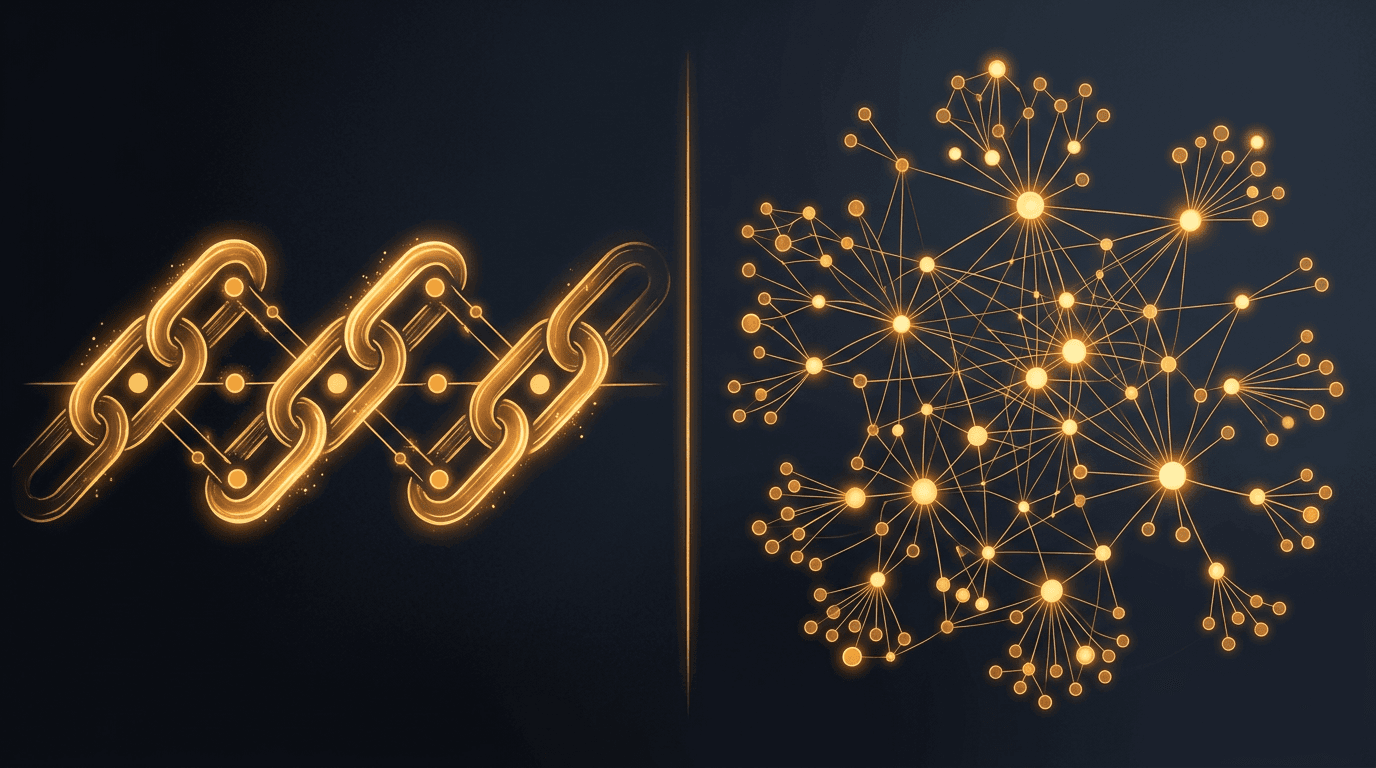
LangChain is one of the most widely-used agent frameworks. When they ship a feature, it signals where the ecosystem is heading. On February 19, 2026, they added persistent memory to Agent Builder, their visual tool for constructing LangGraph agents. The implementation is interesting, the framing is honest, and the gaps are instructive.
I built OMEGA, so I have a stake in this. I will be transparent about where LangChain's approach is clever and where OMEGA differs. The comparison table below is sourced from their blog post and our published benchmarks.
What LangChain Shipped
Agent Builder memory uses a virtual filesystem backed by Postgres. Every agent gets a set of files that it can read, list, and update during task execution. These files are categorized using the COALA framework into two memory types:
Procedural memory covers operational knowledge: an AGENTS.md file with agent instructions and a tools.json that tracks which external tools are available. The agent updates these files as it learns how to do its job better.
Semantic memory covers domain knowledge: custom files the agent creates to store facts, skills, and context. An agent handling customer support might create product_faq.md or escalation_patterns.md. The agent decides what files to create and how to organize them.
Episodic memory, the third pillar of the COALA framework, is absent. LangChain explicitly calls this out as planned for the future. Without it, agents cannot recall specific past interactions or reason about temporal sequences of events.
Learning happens in-session. When an agent completes a task, it reviews what happened and decides whether to update its memory files. All edits require explicit human approval before being persisted, which is a thoughtful security boundary.
Why this matters
LangChain shipping memory validates the category.
When a framework with LangChain's adoption adds persistent memory, it signals that the industry has accepted a core premise: stateless agents are not enough. The question is no longer whether agents need memory, but how to implement it well.
Head-to-Head: 8 Dimensions
Every claim in this table is sourced from LangChain's blog post or OMEGA's published benchmarks.
What LangChain Does Well
The filesystem metaphor is genuinely clever. Files are a universal abstraction that every LLM already understands. Agents do not need special memory APIs; they use the same read/write/list operations they use for any file-based tool. This lowers the barrier to building agents that learn, because the memory primitives are already in the model's training distribution.
Human-in-the-loop approval for all memory edits is a strong security boundary. Memory poisoning is a real attack vector: if an agent can silently write to its own instructions, a single malicious input can corrupt all future behavior. LangChain's decision to require explicit approval for every memory update is conservative and correct, especially for production deployments where trust boundaries matter.
The COALA framework provides solid theoretical grounding. Rather than treating memory as an unstructured dump, LangChain separates procedural knowledge (how to operate) from semantic knowledge (what to know). This distinction maps to how human memory works and gives agents a clearer model for what to store where.
What's Missing
LangChain is transparent about the current limitations. Several of these are on their roadmap. The question is whether you need them now.
No semantic search. This is the most significant gap. Agent Builder memory has no way to find relevant memories by meaning. If an agent stored a fact about "authentication timeouts" and later needs information about "login session expiry," there is no retrieval mechanism to connect those concepts. The agent must know the exact filename to look up. LangChain lists semantic search as a planned feature. OMEGA uses hybrid BM25 + vector search with FTS5 and ONNX embeddings to find relevant memories regardless of how they were originally phrased.
No episodic memory. Without episodic memory, agents cannot recall specific past interactions. They cannot answer questions like "what happened the last time we deployed to staging?" or "what error did we see when we tried this approach before?" OMEGA stores temporal metadata with every memory, enabling queries scoped to time ranges and supporting a bi-temporal model that tracks both when something happened and when it was recorded.
No cross-project recall. Each Agent Builder agent has its own isolated memory. Lessons learned in one agent are invisible to another. If you build ten agents, each starts from zero. OMEGA's memory graph spans all projects and agents. A debugging pattern learned in one context is available everywhere.
No contradiction detection. When an agent updates a memory file, there is no mechanism to check whether the new content conflicts with existing knowledge. LangChain acknowledges a "compaction challenge" where agents tend to list specific cases rather than generalizing, leading to memory bloat. OMEGA uses cross-encoder models to detect contradictions at store time, automatically superseding outdated information and flagging conflicts for review.
No temporal model. Memory files have no timestamps, no concept of when knowledge was acquired, and no mechanism for strength decay over time. A fact stored six months ago has the same weight as one stored today. OMEGA tracks creation time, last access time, and applies configurable strength decay so that stale memories naturally recede while frequently-accessed memories remain prominent.
No published benchmarks. LangChain has not published accuracy numbers on any standard memory benchmark. Without data, users cannot evaluate retrieval quality or compare against alternatives. OMEGA is #1 on LongMemEval with 95.4% task-averaged accuracy across 500 questions.
Locked to LangGraph. Agent Builder memory only works within the LangGraph/LangSmith ecosystem. If you use Claude Code, Cursor, Windsurf, or any other agent client, you cannot access it. OMEGA runs as an MCP server that works with any MCP-compatible client, making it model-agnostic and framework-independent.
When to Use What
LangChain Agent Builder memory if...
- ✓You are already building agents in LangGraph and want basic preference learning
- ✓Your agents operate independently and do not need to share knowledge across projects
- ✓You need human-in-the-loop approval for every memory write as a hard requirement
- ✓You do not need semantic search or temporal queries yet and can wait for LangChain's roadmap
OMEGA if...
- ✓You need semantic search to find memories by meaning, not filename
- ✓You work across multiple projects and want cross-project recall
- ✓You need multi-agent coordination with file claims, task queues, and messaging
- ✓You want benchmark-proven reliability (95.4% on LongMemEval, #1 overall)
- ✓You use Claude Code, Cursor, Windsurf, or any MCP client, not just LangGraph
- ✓You want local-first memory with zero cloud dependency and no API keys
The two systems are not mutually exclusive in principle, but they serve different architectures. LangChain memory is tightly coupled to Agent Builder. OMEGA is a standalone memory layer that plugs into any agent framework via MCP.
Get started
Two commands. Zero cloud. Full memory.
Works with Claude Code, Cursor, Windsurf, Zed, and any MCP client. Local-first. No API keys. No cloud. Full quickstart guide.