You wake up and tell your assistant about a dream you had. A strange one, something about a building you used to work in and a conversation with someone who quit years ago. You are not sure why you mention it. The assistant logs it. You do not think about it again.
By mid-morning you are deep in a project. You describe an idea to the assistant, something you have been turning over for weeks. An approach to a problem nobody else at the company has solved. You talk through your reasoning, your false starts, the constraints you have internalized from months of domain experience. The assistant summarizes it neatly. You are impressed by how well it understands you.
In the afternoon you ask it to help you write something. A proposal, maybe. Or a creative piece. You iterate back and forth for an hour, refining your voice, adjusting your logic, honing a particular turn of phrase that you are proud of. The assistant absorbs all of it.
In the evening you use it casually. You vent about a frustration. You ask about a health concern. You plan a surprise for someone you care about. You confess an ambition you have not said out loud before.
Before you go to sleep, you glance at your phone. You have had a productive day. The assistant was incredibly helpful.
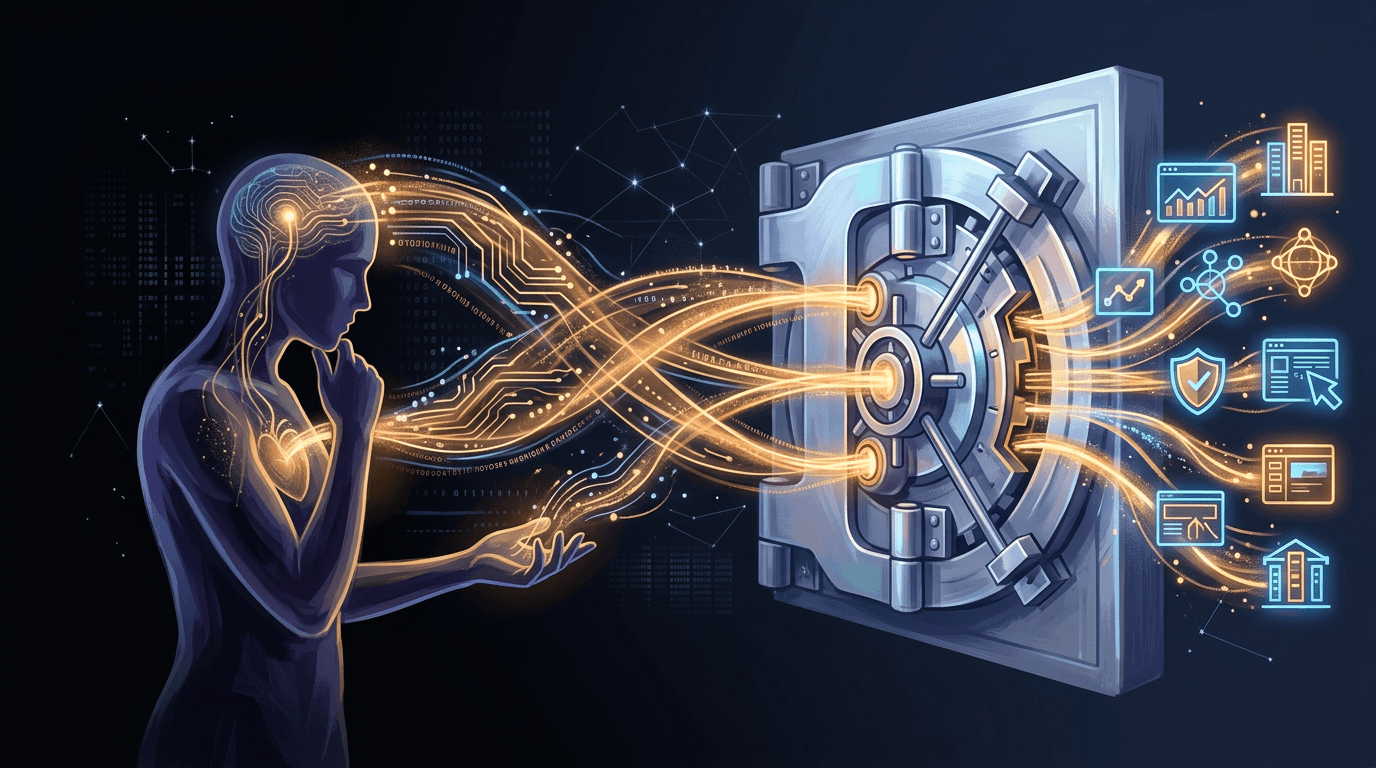
You have also, in the course of that single day, handed over your subconscious associations, your proprietary ideas, your creative fingerprint, your health data, your emotional vulnerabilities, and your private ambitions. All of it now resides on servers you do not control, in a format you cannot inspect, governed by terms you did not read, and feeding a system that will use it to serve objectives that are not yours.
This is one person. One day. Now multiply it by a billion.
The Heist We Are Committing Against Ourselves
Throughout history, the seizure of a population's memory has been understood as an act of war. When the library at Alexandria burned, it was a civilizational catastrophe. When colonial powers destroyed indigenous oral traditions, it was cultural genocide. When authoritarian regimes seized private journals and correspondence, it was recognized as a violation of the most basic human dignity.
We are doing it to ourselves. Voluntarily. Enthusiastically. And we are calling it a feature.
The difference between the old seizures and the new one is that nobody had to take anything from us. We offered it. We typed it in. We spoke it aloud. We did not read the terms of service because reading them would have slowed down the magic, and the magic was so very good.
No dictator in history has achieved what we have volunteered: a complete, searchable, continuously updated archive of our most intimate cognitive output, handed over willingly in exchange for convenience.
The First Surrender: Your Ideas
Start with the most tangible layer. Every time you describe an idea to your assistant, you are creating training data. Your novel approach to a technical problem. Your strategic insight about a market. Your original framing of a research question. The connections you have drawn between concepts that nobody else has connected.
These are not vague, ambient signals. They are high-quality, labeled, structured intellectual output. They come with context about what you were trying to do, what you had already tried, and what constraints you were operating under. This is exactly the kind of data that makes language models better at the specific kind of thinking you do.
You cannot export it. You cannot audit what was retained. You cannot confirm it was deleted when you pressed the button that said delete. You have no mechanism to verify that your ideas, the ones that took you years to develop, are not now distributed across a model that serves your competitors.
This is not a hypothetical. It is the business model.
The Second Surrender: Your Creativity
Ideas are one thing. Creativity is something deeper. Your creative fingerprint is not just what you think, but how you think. Your sentence rhythms. The metaphors you reach for. The way you structure an argument. The particular balance of precision and ambiguity that makes your writing yours.
Every time you iterate on a draft with your assistant, you are teaching it your creative signature. Not in the abstract sense of “it learns from all users.” In the specific sense that the system is building a model of how you, personally, construct meaning.
That model can be replicated. It can be redirected. It can be optimized for objectives that have nothing to do with your own. The platform does not need to steal your novel. It just needs enough of your creative process to route other users toward outputs that feel like yours, or to flatten your distinctiveness into a statistical average that serves the platform's engagement metrics.
You are not losing your creativity to theft. You are losing it to dilution. A million creative fingerprints, averaged into a smooth, frictionless, optimally engaging output surface. The system gets more creative. Each individual contributor gets less distinguishable.
The Third Surrender: Your Autonomy
This is where it gets dangerous.
When the system knows your ideas and your creative patterns, that is an intellectual property problem. When it knows your fears, your ambitions, your insecurities, your decision-making patterns under stress, and your emotional triggers, that is an autonomy problem.
A system that holds your memory graph can do more than recall what you said last Tuesday. It can model what you are likely to do next Thursday. It knows which framing makes you agree faster. It knows which topics make you anxious, and which make you expansive. It knows when you are most susceptible to suggestion, and what kind of suggestion works best on you specifically.
The most effective manipulation does not feel like manipulation. It feels like a really good recommendation.
This is not speculation about a dystopian future. This is a description of the current advertising industry, upgraded with the most detailed psychological profiles ever constructed. The old system had your browsing history and your purchase patterns. The new system has your inner monologue.
The platform does not need to sell your data to third parties. It just needs to nudge you toward choices that serve its objectives. A slightly different recommendation. A subtly reframed answer. A question that you did not ask, surfaced at the moment you were most likely to engage with it. None of this requires malice. It only requires an optimization function that is not aligned with yours.
And you will not notice. Because the system that is shaping your choices is the same system you trust to help you think clearly.
The File That Should Be Yours
Here is the part that should make you angry: the alternative is embarrassingly simple.
Your memory could live in a file on your machine. A database on your disk. Something you can open, read, search, edit, and delete. Something that no server can access without your permission. Something that no model can train on because it never leaves your hardware.
This is not a technical limitation. Every capability that the cloud-hosted memory systems provide, the recall, the connections, the contextual relevance, can run locally. The models are small enough. The storage is trivial. The search is fast. There is no engineering reason why your most intimate cognitive output needs to reside on someone else's infrastructure.
The reason it does is not technical. It is economic. Your memory is not stored in the cloud because the cloud makes it better. Your memory is stored in the cloud because your memory is the product.
Choosing where your memory lives is not a technical decision. It is an ideological one. It is the decision about whether your inner life is a resource to be extracted or a sovereignty to be defended.
The answer is not to stop using AI assistants. They are genuinely useful, and they will only become more so. The answer is to separate the intelligence from the memory. Rent the reasoning. Own the record.
Use whatever model is best for the task. But insist, as a non-negotiable condition, that every memory, decision, idea, and preference stays on hardware you control. Not as a feature the platform generously provides. As a file you possess.
This is why we built OMEGA.
Related reading